
Model analysis roadmap
A forecast of "40% home win" is a claim that can only be tested in bulk: over many matches given 40%, the home team should win about 40% of the time. That property is called calibration, and it is the first thing to check about any probability model. This post shows how to measure it, how to read the results and why calibration alone is not enough.
The reliability table
Group the forecasts into bins and compare the average forecast in each bin with how often the outcome actually happened.
| Forecast bin | Matches | Average forecast | Actual frequency |
|---|---|---|---|
| 0–20% | 410 | 13% | 12% |
| 20–40% | 980 | 31% | 33% |
| 40–60% | 620 | 49% | 45% |
| 60–80% | 290 | 68% | 61% |
| 80–100% | 40 | 85% | 78% |
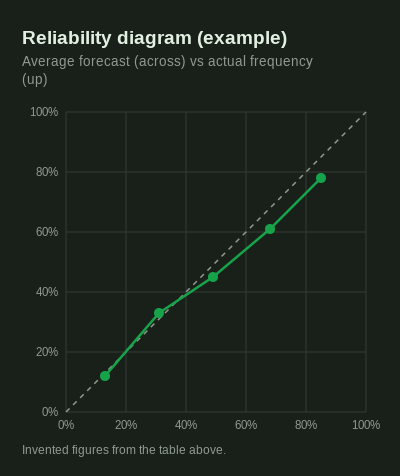
Invented figures to show the method. Each row counts forecasts of a single outcome (for example home win) that fell into the bin.
Reading it
- Low bins match well: forecasts under 40% happen about as often as predicted.
- High bins are overconfident: events forecast at 68% happened only 61% of the time, and at 85% only 78%.
This pattern, accurate at low probabilities and overconfident at high ones, is common in football models that rate favourites too highly. The fix is usually to shrink extreme forecasts towards the middle.
Key point: Plot average forecast against actual frequency and you get a reliability diagram. A perfectly calibrated model sits on the diagonal; points below it at the top end mean overconfidence.
How many matches you need
Calibration needs data. With 40 matches in a bin, the actual frequency has a standard error of about 6 percentage points, so the gap between 85% and 78% in the example is not yet conclusive. Bins with a few hundred matches are far more reliable. That is one reason a model cannot be judged after a few weeks.
Calibration is not enough
A model that forecasts the league-average frequencies for every match (home 44%, draw 26%, away 30%) can be perfectly calibrated and completely useless: it never tells you anything about a specific match. A useful model is both:
- calibrated: its probabilities mean what they say;
- sharp: it moves away from the average when the evidence supports it.
Proper scoring rules such as the Brier score and log loss reward both at once, which is why they are used as the headline measure. See Brier Score and Log Loss Explained.
Fixing poor calibration
When a model is consistently overconfident, two simple fixes work well. The first is to shrink its probabilities towards the league averages, for example by blending 90% model with 10% base rates. The second is to recalibrate: fit a small correction that maps the model's raw probabilities onto the frequencies actually observed in past seasons. Both must be fitted on past data and tested on new seasons, or the fix itself becomes a source of overfitting.
Calibration against the market
A useful extra check is to run the same reliability table on the market's margin-free probabilities over the same matches. Betting markets are usually well calibrated, so if the model's table looks worse than the market's in the same bins, that is a clear signal where the model is weakest.
Watch out: A model can look calibrated overall and still be badly miscalibrated for a subset: draws, away favourites, early-season matches. Check the important subsets separately before trusting the headline table.
To compare a model's probabilities with the market's for a single match, use the model vs market calculator.
- A calibrated model's 40% forecasts come true about 40% of the time.
- Check calibration with a reliability table and enough matches per bin.
- Calibration must be combined with sharpness; proper scoring rules measure both.
Count the forecasts behind each bin
A reliability point based on few matches is unstable even when it sits neatly on the diagonal. Report bin counts and compare sharpness as well as calibration. A model that always repeats a base rate can be calibrated without offering useful distinctions between fixtures.
18+ only. Model probabilities are estimates, not advice. See our Responsible Gambling page.